
Book Athens Transfers for a Mycenae, Epidaurus and Nafplio Day Trip
Book Athens Transfers for a Mycenae, Epidaurus and Nafplio Day Trip
Mycenae, Epidaurus, and Nafplio create one of the most rewarding full-day routes from Athens. In a single journey, you can move from a Bronze Age citadel to an ancient healing sanctuary and theatre, then finish in the elegant first capital of modern Greece. Book Athens Transfers provides a comfortable way to connect all three destinations.
Why Combine Mycenae, Epidaurus and Nafplio?
The three destinations are different enough that the day never feels repetitive.
Mycenae introduces the fortified world of the Late Bronze Age and a civilization whose name now describes an entire period of Greek history.
Epidaurus moves the story forward into the Classical world, with the Sanctuary of Asklepios and its extraordinary theatre.
Nafplio then shifts the focus toward Venetian fortifications, the Greek War of Independence, neoclassical architecture, and the formation of the modern Greek state.
Together, they create a historical journey across several thousand years.
The route is ambitious, however, and works best when planned carefully. Leaving Athens early gives each destination enough time without turning the entire day into a race.
Distance and Travel Time from Athens
The exact distance depends on the order of stops and your pickup location, but a complete Mycenae, Nafplio, and Epidaurus circuit generally involves several hundred kilometers of driving over the course of the day.
From Athens, Mycenae is normally the most logical first major stop because it lies north of Nafplio and provides a natural entry into Argolis.
Nafplio can then serve as a midday or early-afternoon break before continuing toward Epidaurus, or the route can be reversed depending on opening hours, seasonal conditions, and your priorities.
A private tranfer with Book Athens Transfers is particularly useful for a multi-stop day because the itinerary can be organized as one continuous journey rather than a collection of unrelated transfers.
First Stop: Mycenae
Mycenae was one of the most important centers of the Late Bronze Age Greek world.
The fortified citadel stands above the surrounding Argive landscape and immediately communicates the defensive power of the site.
Its most recognizable entrance is the Lion Gate, where two monumental animals face across a central column above the gateway.
Passing through this entrance is one of the defining experiences of a visit.
Inside the citadel, visitors encounter remains connected with palatial structures, religious activity, houses, fortification walls, and the elite society that dominated the region more than three thousand years ago.
The Mycenaean World
The archaeological site is important not simply because of individual monuments but because Mycenae helped define our understanding of an entire civilization.
The term “Mycenaean” is used for the Late Bronze Age culture that flourished across mainland Greece and interacted with the wider eastern Mediterranean.
Its palaces, monumental tombs, administrative systems, art, warfare, and trade created a world very different from the Classical Athens that developed centuries later.
Mycenae also became deeply connected with later Greek mythology.
Stories surrounding Agamemnon, the Trojan War, and the tragic House of Atreus gave the site a powerful place in Greek literary imagination long after the Bronze Age civilization had disappeared.
The Treasury of Atreus
Near the citadel stands one of the most impressive Mycenaean tholos tombs, traditionally known as the Treasury of Atreus.
A long approach passage leads toward a monumental doorway and a large circular burial chamber covered by a corbelled dome.
The engineering is extraordinary.
Even without knowing the technical vocabulary, visitors immediately feel the scale of the structure and the effort required to build it.
The traditional name links the monument with the legendary family of Atreus, although archaeological interpretation is based on its Bronze Age funerary function rather than the later mythology.
Including the tomb makes the Mycenae visit far more complete.
Continue to Nafplio
After Mycenae, Nafplio provides an ideal change of pace.
Instead of another archaeological landscape, visitors enter a living historic city beside the Argolic Gulf.
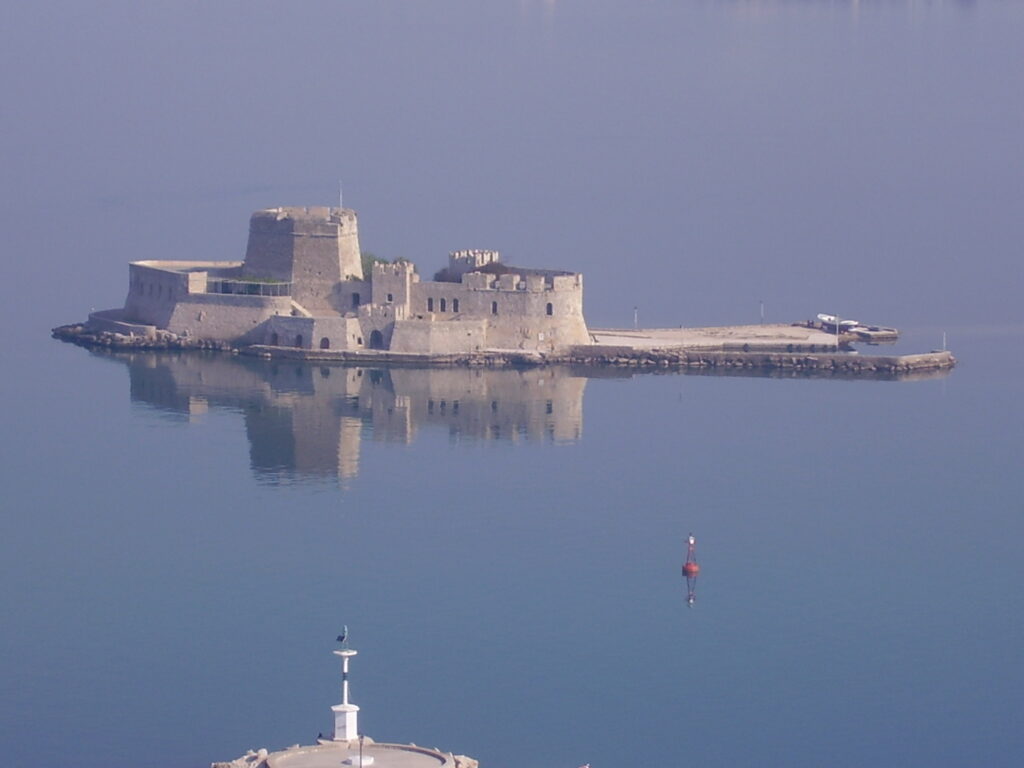
The old town contains pedestrian streets, neoclassical buildings, Venetian and Ottoman traces, shops, cafés, restaurants, and views toward the small fortress of Bourtzi in the harbor.
Nafplio was the first capital of the modern Greek state after independence, adding another completely different period to the day’s historical sequence.
This is also the most natural place for a lunch break.
Sitting near the waterfront for a meal or coffee gives the itinerary breathing room before continuing toward Epidaurus.
Palamidi or the Old Town?
A full exploration of Palamidi Fortress requires additional time, so visitors should decide how important it is within the combined itinerary.
The fortress rises high above the city and provides magnificent views, but climbing the steps and walking through the bastions can consume a significant portion of the day.
If Mycenae and Epidaurus are the archaeological priorities, a shorter Nafplio visit focused on the old town and waterfront may be more realistic.
If fortifications and panoramic views are important, the vehicle-accessible approach to Palamidi can save time and physical effort.
A good combined day trip is not about checking every possible attraction. It is about choosing enough highlights to enjoy each destination properly.
Final Major Stop: Epidaurus
Epidaurus provides another dramatic change of historical setting.
The Sanctuary of Asklepios became one of the ancient world’s most important centers associated with healing.
Visitors came seeking treatment within an environment where religious ritual, sacred sleep, physical care, bathing, exercise, and other practices could form part of the experience.
The archaeological landscape contains remains of temples, healing facilities, accommodation, athletic structures, and ceremonial buildings.
Yet the most famous monument is the Ancient Theatre of Epidaurus.
Its proportions, preserved seating, relationship with the hillside, and celebrated acoustics have made it one of the great architectural achievements of ancient Greece.
The Ancient Theatre at the End of the Day
Ending the cultural sequence at the theatre works particularly well because it introduces an experience unlike anything at Mycenae or Nafplio.
The open auditorium looks across the natural landscape, while the architecture demonstrates a sophisticated understanding of performance space.
During the summer festival season, the theatre continues to host performances, maintaining a living connection with ancient drama.
Travelers planning around an evening performance should treat that as the central timing requirement for the entire day.
Otherwise, current archaeological-site opening hours should be checked before choosing whether Epidaurus comes before or after Nafplio.
What You Experience in One Day
The strength of this itinerary lies in contrast.
At Mycenae, massive fortifications and royal tombs evoke the Bronze Age.
In Nafplio, streets, fortresses, and waterfront architecture reflect medieval, Venetian, Ottoman, and modern Greek history.
At Epidaurus, theatre and healing reveal another dimension of the ancient world.
Few day trips from Athens provide such a broad chronological range.
The route also reveals the changing landscape of the Peloponnese, from inland hills to the Argolic Gulf and the greener setting around Epidaurus.
How Much Time Should You Allow?
This should be treated as a full-day excursion.
An early departure from Athens is strongly recommended.
Mycenae deserves enough time for the citadel and at least one major tomb. Nafplio needs space for a walk and meal rather than just a photograph from the vehicle. Epidaurus deserves more than a five-minute stop at the theatre.
Seasonal heat should also influence the order.
In summer, walking through exposed archaeological sites is more comfortable earlier or later in the day than around midday.
Carry water, wear comfortable footwear, and use sun protection.
Private Transfer for the Peloponnese Day Trip
A private transfer with Book Athens Transfers is particularly well suited to this route because it involves several destinations rather than one simple arrival point.
Your driver can collect you from your hotel, residence, Athens Airport, or another agreed location and continue through the Peloponnese according to the planned sequence.
Private transfer services remove the need to coordinate separate regional connections while allowing the day to remain focused on the destinations themselves.
The exact order can also be planned around seasonal opening schedules and your priorities.
Premium Transfer for Mycenae, Epidaurus and Nafplio
A premium transfer adds comfort to a day containing several hours of road travel.
Executive vehicles are appropriate for couples, private parties, families, business guests, and travelers planning the excursion as a special experience.
The longer return to Athens is particularly important.
After walking through Mycenae, exploring Nafplio, and visiting Epidaurus, having a comfortable vehicle for the journey back can make the day considerably more enjoyable.
Athens Airport Minivan for Families and Groups
An Athens Airport Minivan allows families and larger groups to experience the three destinations together.
Additional passenger space reduces the need to divide between multiple vehicles, while luggage capacity can be useful for travelers incorporating the excursion into a longer Peloponnese journey.
When arranging your athens transfer with Book Athens Transfers, provide passenger numbers, luggage requirements, pickup location, and the stops you want to prioritize.
For larger groups, agreeing on the amount of time at each destination beforehand helps keep the itinerary realistic.
Make the Day About Quality, Not Checklists
Mycenae, Epidaurus, and Nafplio can all justify individual day trips.
Combining them is worthwhile precisely because they complement one another, but the experience becomes less enjoyable if every minute is scheduled too tightly.
Choose the essential elements.
At Mycenae, focus on the citadel and monumental tomb architecture. In Nafplio, enjoy the old town and waterfront unless Palamidi is a major priority. At Epidaurus, explore the theatre and enough of the sanctuary to understand its purpose.
This creates a full but coherent day rather than a sequence of rushed photographs.
Explore Mycenae, Epidaurus and Nafplio with Book Athens Transfers
This route compresses an extraordinary range of Greek history into a single excursion: the Bronze Age power of Mycenae, the healing sanctuary and theatre of Epidaurus, and the elegant modern history of Nafplio.
Booking your athens transfer with Book Athens Transfers provides an organized way to connect all three. Choose private transfer services for a flexible full-day itinerary, a premium transfer for additional comfort, or an Athens Airport Minivan when traveling with family or a larger group.