
Book Athens Transfers to Meteora from Athens
Book Athens Transfers to Meteora from Athens
Meteora is one of Greece’s most extraordinary landscapes, where historic Orthodox monasteries rise above Kalambaka and Kastraki on immense stone pillars. It can be visited from Athens in a very long day, although an overnight stay allows a much slower experience. Book Athens Transfers provides private road transportation toward this UNESCO World Heritage destination.
Distance and Travel Time from Athens to Meteora
Meteora is located in Thessaly in central mainland Greece, far beyond the normal radius of an Athens day trip.
The road distance from central Athens to Kalambaka is approximately 350 kilometers, depending on the route. A direct drive typically takes around 4 to 4 hours 30 minutes each way under normal conditions.
From Athens International Airport, the total distance is somewhat greater.
This means a same-day return can involve eight to nine hours of driving before time spent visiting the monasteries.
Booking a private tranfer with Book Athens Transfers makes the road journey direct and flexible, but travelers should still consider whether a long day or an overnight stay better matches the experience they want.
For many visitors, one night in Kalambaka or Kastraki provides a more comfortable way to appreciate Meteora.
Meteora: Monasteries Suspended Above the Landscape
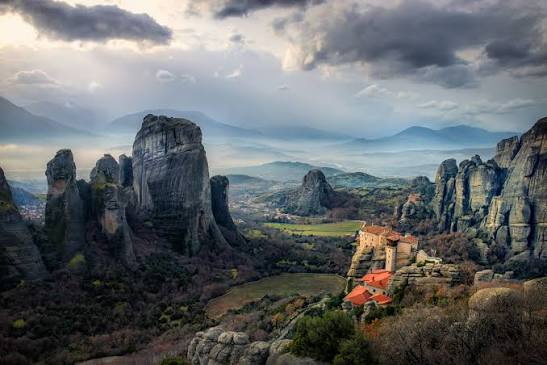
The name Meteora is associated with the extraordinary impression that the monasteries are suspended between earth and sky.
Enormous rock formations rise abruptly from the Thessalian plain, creating vertical cliffs, isolated pillars, and narrow summits.
Hermits were drawn to this landscape many centuries ago because the difficult terrain offered isolation and an environment suited to prayer and ascetic life.
Organized monasticism developed from around the eleventh century onward, while the great period of monastery construction came later.
By the late medieval period, numerous monasteries occupied the rock towers.
The combination of natural landscape and human construction is so distinctive that Meteora is recognized by UNESCO for both cultural and natural significance.
How the Monasteries Were Built
The position of the monasteries raises an obvious question: how were people and materials moved onto such difficult rocks?
Before modern stairs and road access, reaching the summits required extraordinary effort.
Ladders, ropes, nets, winches, and narrow pathways helped transport monks, visitors, food, building materials, and supplies.
The isolation was intentional.
These were not simply buildings placed on impressive viewpoints. Their difficult access formed part of a spiritual environment built around separation from ordinary life.
Modern roads and staircases make several monasteries accessible to visitors today, but the physical setting still communicates how extreme the original conditions were.
The Six Monasteries Open to the Public
Today, six historic monasteries remain active and receive visitors on different schedules.
They are the Great Meteoron, Varlaam, Roussanou, Agios Nikolaos Anapafsas, Holy Trinity, and Agios Stefanos.
Each has a different character.
Great Meteoron is the largest and historically one of the most important. Varlaam contains significant frescoes and monastic spaces. Roussanou appears dramatically integrated with its narrow rock. Holy Trinity is among the most visually spectacular, while Agios Stefanos offers comparatively easier physical access.
Agios Nikolaos Anapafsas is particularly noted for important frescoes by Theophanes the Cretan.
It is rarely realistic to explore every monastery properly during a rushed day from Athens. Two or three carefully chosen monasteries usually provide a better experience.
Great Meteoron
The Great Meteoron, also known as the Monastery of the Transfiguration of the Saviour, occupies one of the most commanding positions in the entire complex.
Founded in the fourteenth century by Saint Athanasios the Meteorite, it developed into the largest monastery at Meteora.
Visitors can see religious spaces, historical objects, former monastic facilities, and exhibitions that help explain life within the community.
The scale of the complex makes it particularly useful for first-time visitors trying to understand Meteora as more than a landscape.
The climb requires physical effort, so allow enough time rather than treating it as a brief roadside stop.
Varlaam Monastery
Varlaam stands opposite Great Meteoron and is another important destination.
The monastery developed substantially during the sixteenth century and preserves notable frescoes, religious architecture, and spaces associated with monastic life.
Its position provides magnificent views across surrounding rocks and valleys.
Seeing both Varlaam and Great Meteoron also demonstrates how the communities existed in visual proximity while remaining physically separated by enormous cliffs.
This relationship between closeness and isolation is central to understanding Meteora.
Roussanou, Holy Trinity and Agios Stefanos
Roussanou occupies a narrow rock formation and creates one of the classic images of Meteora.
Its compact architecture seems almost inseparable from the stone supporting it.
Holy Trinity is equally dramatic and requires a more demanding approach, rewarding visitors with exceptional views.
Agios Stefanos differs because access is easier, making it particularly useful for visitors who may struggle with the longer stair climbs found elsewhere.
Choosing monasteries should therefore depend not only on fame but also on available time, opening schedules, physical ability, and the type of experience you want.
Monastery Opening Days Matter
Meteora cannot be planned successfully without checking current monastery schedules.
The monasteries maintain separate opening hours and closing days, and schedules can change between seasons.
Religious services, special dates, restoration work, and other circumstances may also affect access.
Because of this, avoid building a detailed itinerary months in advance around assumptions that every monastery will be open on the same day.
Shortly before travelling, confirm the current schedules and choose the most realistic combination.
Visitors should also respect monastery dress requirements and the religious character of the sites.
Kalambaka Below the Rocks
Kalambaka sits directly beneath Meteora and functions as the principal town for visitors.
Hotels, restaurants, cafés, shops, and other services make it a practical base for an overnight stay.
The contrast between the town and cliffs above is dramatic.
From many streets, the rock formations appear almost impossibly large.
Staying overnight allows travelers to experience this setting after day-trip traffic begins to disappear.
Dinner in Kalambaka followed by an early start the following morning can transform Meteora from a rushed excursion into a much more balanced trip.
Kastraki Village
Kastraki lies even closer to the rocks and offers a quieter atmosphere than Kalambaka.
Traditional houses, guesthouses, tavernas, and narrow streets sit directly beneath the stone formations.
For travelers interested in photography, walking, or landscape, Kastraki can be particularly attractive.
The village provides easy access to several roads and trails around Meteora while retaining a smaller scale.
An overnight stay here allows early-morning and late-evening light to become part of the experience.
Meteora for Photography
Meteora is one of the most visually distinctive landscapes in Greece.
The challenge for photographers is not finding a subject but choosing among too many possibilities.
Wide compositions can place monasteries within the enormous rock landscape. Longer focal lengths can isolate individual buildings against cliffs or distant mountains.
Sunrise and sunset create especially dramatic conditions when weather cooperates.
Changing mist, clouds, and seasonal vegetation can completely transform the atmosphere.
A same-day trip from Athens often misses the best light because the schedule is dominated by road travel.
This is another reason photographers may prefer an overnight stay.
Is Meteora Really a Day Trip from Athens?
A private transfer with Book Athens Transfers provides direct transportation from your Athens hotel, residence, Athens International Airport, or another agreed pickup location toward Kalambaka and Meteora.
Private transfer services are particularly useful for long-distance journeys because departure time, rest stops, and the broader itinerary can be planned in advance.
For a same-day return, leaving very early is essential.
For an overnight itinerary, the transfer can take you directly to accommodation in Kalambaka or Kastraki, allowing monastery visits to be divided across two days.
Premium Transfer to Meteora
A premium transfer provides additional comfort during one of the longest road excursions in this Athens series.
Executive vehicles are particularly suitable for couples, private groups, business guests, special occasions, or travelers who value comfort during several hours on the motorway.
For Meteora, vehicle comfort matters more than it does on a short central-Athens journey.
A full return day may involve eight or more hours on the road.
Choosing a premium transfer can therefore make a substantial difference to the overall experience.
Athens Airport Minivan for Families and Groups
An Athens Airport Minivan is a practical option for families and larger groups travelling together to Meteora.
The additional passenger and luggage capacity is especially useful when the journey includes an overnight stay.
When arranging your athens transfer with Book Athens Transfers, provide passenger numbers, luggage requirements, accommodation details if applicable, and whether you are planning a same-day return or multi-day trip.
A group can then travel together without coordinating several vehicles across a long-distance route.
One Day or Two Days?
A one-day itinerary is best for travelers whose schedule is extremely limited.
Leave Athens before sunrise, visit a carefully selected group of monasteries, stop at several viewpoints, and return in the evening.
A two-day itinerary is better for almost everyone else.
Day one can include the journey from Athens, Kalambaka or Kastraki, viewpoints, and perhaps one or two monasteries. Day two allows additional monasteries, walking, photography, or a slower morning before returning.
The extra time also provides flexibility if weather affects visibility.
Experience Meteora with Book Athens Transfers
Meteora is not simply a collection of monasteries.
It is a landscape where geology, Orthodox Christianity, medieval monasticism, architecture, art, and centuries of human adaptation exist together.
The six operating monasteries preserve only part of a much larger historical monastic world that once occupied these extraordinary rocks.
Booking your athens transfer with Book Athens Transfers provides an organized road journey from Athens or Athens International Airport toward Meteora. Choose private transfer services for a direct long-distance excursion, a premium transfer for additional comfort, or an Athens Airport Minivan for families and larger groups.
For the fullest experience, consider staying overnight and allowing Meteora the time its scale deserves.