
Book Athens Transfers to Ancient Corinth and the Corinth Canal
Book Athens Transfers to Ancient Corinth and the Corinth Canal
Ancient Corinth and the Corinth Canal create one of the most varied day trips from Athens. Within the same excursion, visitors can look down into a narrow engineering channel cut through the Isthmus, then walk through the remains of one of the ancient Greek world’s wealthiest cities beneath the fortress of Acrocorinth.
Distance and Travel Time from Athens to Corinth
Corinth lies west of Athens at the gateway to the Peloponnese.
The Corinth Canal is roughly 80 kilometers from central Athens, while Ancient Corinth lies a little farther beyond it. Under normal road conditions, the drive to the canal generally takes around 1 hour to 1 hour 20 minutes. Ancient Corinth can usually be reached shortly afterward.
Traffic leaving Athens can affect travel times, especially during weekends, holiday periods, and summer departures toward the Peloponnese.
Booking a private tranfer with Book Athens Transfers allows both the canal and archaeological site to be incorporated into the same planned route.
Because the destinations are close enough to complement one another, there is little reason to choose between engineering history and ancient archaeology when you have a full day available.
The Isthmus of Corinth
The geography of Corinth explains much of its history.
A narrow strip of land, the Isthmus of Corinth, connects mainland Greece with the Peloponnese. On one side lies the Gulf of Corinth and on the other the Saronic Gulf.
For thousands of years, this position gave the region enormous strategic and commercial importance.
Ships traveling between the two seas faced a long voyage around the Peloponnese unless cargo or vessels could somehow cross the Isthmus.
Ancient engineers, rulers, and later governments repeatedly considered ways to overcome this geographical obstacle.
The modern Corinth Canal represents the most dramatic solution.
The Corinth Canal
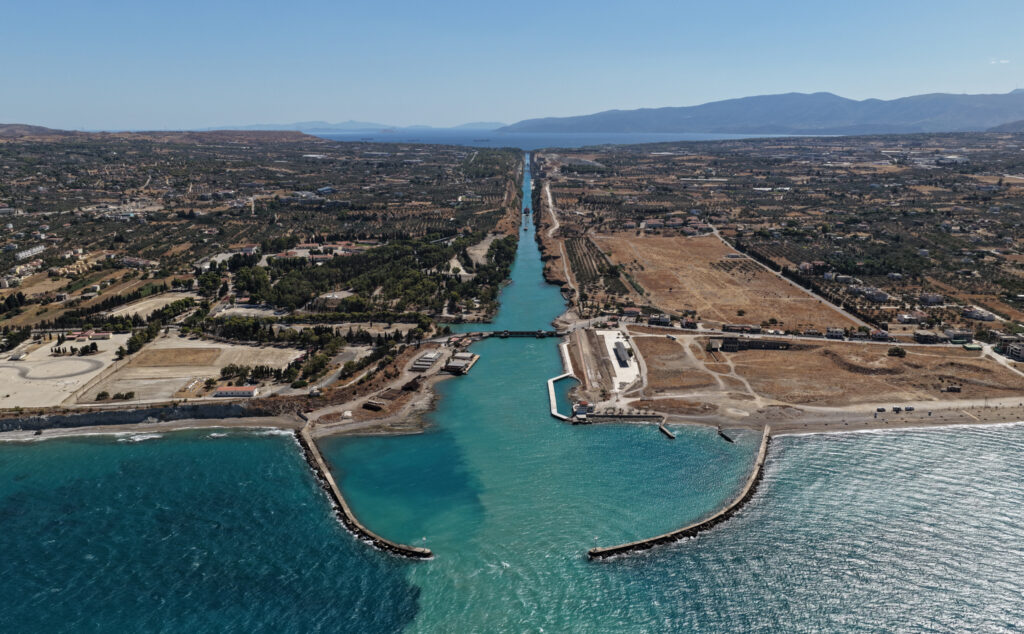
The Corinth Canal cuts in a straight line through the Isthmus for more than six kilometers.
Its steep walls rise dramatically above the narrow waterway, creating one of the most recognizable engineered landscapes in Greece.
The idea of cutting through the Isthmus is ancient, and attempts or plans appeared under several rulers. The modern canal was finally completed in the nineteenth century.
Today, standing on a bridge above the channel gives visitors the clearest impression of its proportions.
When a vessel passes below, the narrowness of the canal becomes especially obvious.
The canal is not simply a photo stop. It represents a long history of people attempting to reshape the geography that made Corinth strategically important in the first place.
Ancient Corinth: A City Between Two Seas
Ancient Corinth became wealthy partly because of its position near routes connecting different regions and seas.
Its commercial importance, fertile surrounding land, ports, and strategic location helped make it one of the major cities of the ancient Greek world.
The archaeological site visible today contains monuments from several historical periods, including the Greek and Roman eras.
Visitors walk through a landscape of temples, public spaces, fountains, shops, and civic buildings that developed as the city changed over centuries.
This layered character is important. Corinth should not be understood as a perfectly preserved city from one moment in history.
Instead, its ruins reveal repeated rebuilding and adaptation.
The Temple of Apollo
The Temple of Apollo is the most immediately recognizable ancient monument at Corinth.
Its surviving Doric columns date from the Archaic period and stand prominently above the surrounding ruins.
The temple predates the extensive Roman city visible across much of the archaeological site, making it an important reminder of Corinth’s earlier Greek history.
The heavy proportions of the columns also create a strong visual contrast with later structures around the forum.
For photographers, the temple works particularly well when viewed in relation to the mountains and Acrocorinth rising behind the site.
Roman Corinth and the Forum
Corinth was destroyed by Roman forces in 146 BC and later refounded as a Roman colony.
The city once again became prosperous, and much of the archaeological landscape reflects this Roman phase.
Visitors can explore the large forum and remains associated with commercial, administrative, religious, and everyday urban life.
Fountains and water systems also played an important role in the city, with the Peirene Fountain among the most famous features associated with ancient Corinth.
The mixture of Greek and Roman remains makes the site especially useful for understanding how ancient cities evolved rather than remaining fixed in one historical period.
Corinth and Early Christianity
Corinth also became important in the history of early Christianity.
The Apostle Paul spent time in the city, and his letters to the Corinthians became part of the New Testament.
For Christian visitors, this gives the archaeological site an additional layer of meaning beyond its Greek and Roman history.
The ancient city’s commercial importance and diverse population help explain why Corinth became significant in the spread of early Christianity through the Mediterranean world.
This religious history attracts many visitors who combine archaeological interest with pilgrimage.
The Archaeological Museum of Ancient Corinth
The museum beside the site helps organize the long history of Corinth.
Artifacts from different periods provide context for the temples, public spaces, cemeteries, and everyday life represented by the ruins outside.
Visiting the museum is particularly valuable because many details that disappear in a large archaeological landscape become clearer when examining sculpture, pottery, inscriptions, mosaics, and smaller objects.
Allowing time for both the museum and outdoor site creates a much stronger understanding of the ancient city.
Acrocorinth Above the Ancient City
Acrocorinth rises dramatically above Ancient Corinth.
The fortified hill controlled the surrounding landscape and remained strategically important across Greek, Roman, Byzantine, Frankish, Venetian, and Ottoman periods.
Its surviving walls, gates, religious structures, cisterns, and ruins reflect this long history.
The views from the heights also make the strategic geography immediately understandable. From above, visitors can appreciate the relationship between the Corinthian plain, the Isthmus, the two gulfs, and routes into the Peloponnese.
Visiting Acrocorinth requires more time and physical effort than a simple stop at the canal, so include it only if the day’s schedule allows a relaxed pace.
Combine the Canal, Ancient Corinth and Acrocorinth
A well-planned Corinth day trip can contain three distinct experiences.
Start at the canal for the engineering landscape and geographical introduction. Continue to Ancient Corinth for the Temple of Apollo, Roman Forum, museum, and historical context. Then, if time and energy allow, climb or drive toward Acrocorinth to see the fortified landscape from above.
The combination works because each destination explains the others.
The canal demonstrates the importance of crossing the Isthmus. Ancient Corinth shows the wealth created by the region’s strategic position. Acrocorinth reveals how that same geography needed to be defended.
Together, they create a much richer excursion than any single stop alone.
Add Loutraki for a More Relaxed Day
Travelers who prefer a less archaeology-heavy itinerary can combine Corinth with Loutraki.
The coastal town lies beside the Gulf of Corinth and offers a waterfront promenade, restaurants, and a more relaxed atmosphere.
This can be especially pleasant after several hours of walking through archaeological sites.
Rather than adding Acrocorinth, some visitors may prefer lunch beside the sea before returning to Athens.
The best version of the day depends on whether your priority is history, scenery, food, or a balanced mixture.
Private Transfer from Athens to Corinth
A private transfer with Book Athens Transfers provides direct transportation from Athens toward the Corinth Canal and Ancient Corinth.
Your pickup can be arranged from a hotel, apartment, Athens Airport, or another agreed location.
Private transfer services are particularly useful for a multi-stop day because the canal, archaeological site, Acrocorinth, and Loutraki are separate destinations rather than one walkable attraction.
Planning the route beforehand also allows the day to focus on the places you actually want to see.
Premium Transfer to Ancient Corinth
A premium transfer provides additional comfort for the journey toward the Peloponnese.
Executive vehicles are suitable for couples, business travelers, special occasions, or visitors who prefer a more refined road experience.
The drive is shorter than a Delphi excursion, leaving more flexibility for stops and a slower lunch.
A premium transfer can also work well when Corinth is the first stage of a longer itinerary continuing toward Mycenae, Nafplio, or other Peloponnese destinations.
Athens Airport Minivan for Families and Groups
An Athens Airport Minivan provides additional space for families and larger groups traveling to Corinth.
Keeping everyone together makes a multi-stop itinerary easier to coordinate and gives groups more flexibility over departure times and rest breaks.
When arranging your athens transfer or excursion with Book Athens Transfers, provide passenger numbers and the destinations you want to include.
Families should also account for sun exposure and walking conditions at archaeological sites, particularly during the hottest months.
Discover Why Corinth Mattered
The greatest strength of a Corinth day trip is that geography, engineering, and history all connect.
The Isthmus made the region strategically valuable. Ancient Corinth became wealthy partly because of that position. Acrocorinth protected the landscape from above. Centuries later, engineers cut the canal through the same narrow strip of land that had shaped human movement since antiquity.
Seeing these places together allows visitors to understand Corinth rather than simply photograph it.
Arrive at Ancient Corinth and the Corinth Canal with Book Athens Transfers
The Corinth Canal and Ancient Corinth offer one of the most varied excursions within relatively easy reach of Athens. Visitors can stand above the narrow canal, walk beside the Temple of Apollo, explore the Roman Forum and museum, and look across the region from Acrocorinth.
Booking your athens transfer with Book Athens Transfers provides an organized journey toward the Isthmus and Peloponnese. Choose private transfer services for a direct itinerary, a premium transfer for additional comfort, or an Athens Airport Minivan when traveling with family or a larger group.