
Book Athens Transfers to Mycenae
Book Athens Transfers to Mycenae
Mycenae takes visitors into a world older than Classical Athens. Massive stone walls, the Lion Gate, royal graves, palace remains, and monumental tombs occupy a strategic hill overlooking the Argolid landscape. The site gave its name to the Mycenaean civilization and remains inseparable from stories of Agamemnon, Troy, and the heroic age of Greek tradition.
Distance and Travel Time from Athens to Mycenae
Mycenae lies in the northeastern Peloponnese, roughly 120 to 130 kilometers from central Athens depending on the route.
A direct road journey generally takes around 1 hour 30 minutes to 2 hours under normal conditions. Traffic leaving Athens and conditions around the Corinth corridor can affect the total travel time.
The route crosses the Isthmus of Corinth before continuing into the Argolid region, making Mycenae easy to combine with other destinations in the Peloponnese.
Booking a private tranfer with Book Athens Transfers allows the journey to begin directly from your hotel, apartment, Athens Airport, or another agreed location.
An early departure is especially useful if you plan to combine Mycenae with Epidaurus or Nafplio.
Mycenae and the Bronze Age
Mycenae flourished during the Late Bronze Age and became one of the most important centers of the civilization now known by its name.
The Mycenaean world developed powerful palatial centers, extensive trade networks, monumental architecture, sophisticated crafts, and an administrative system that used Linear B, the earliest known written form of the Greek language.
Mycenae was not the only center of this civilization, but its archaeological importance and later legendary reputation made it the defining name for the entire period.
Walking through the citadel gives visitors a very different experience from Classical sites such as the Acropolis or Temple of Olympian Zeus.
The architecture is heavier, more defensive, and deeply connected with the landscape.
A UNESCO World Heritage Site
Mycenae and nearby Tiryns are recognized together as a UNESCO World Heritage property.
Their monumental fortifications, palace architecture, tombs, artistic achievements, and influence on later Greek culture make them central to understanding the Bronze Age Aegean.
UNESCO also emphasizes their deep connection with the Homeric epic tradition.
The world described in the Iliad and Odyssey cannot simply be treated as a direct historical record of Mycenaean Greece, but archaeological discoveries at sites such as Mycenae transformed modern understanding of the period behind those traditions.
This relationship between archaeology and epic storytelling is one of the site’s enduring attractions.
The Lion Gate
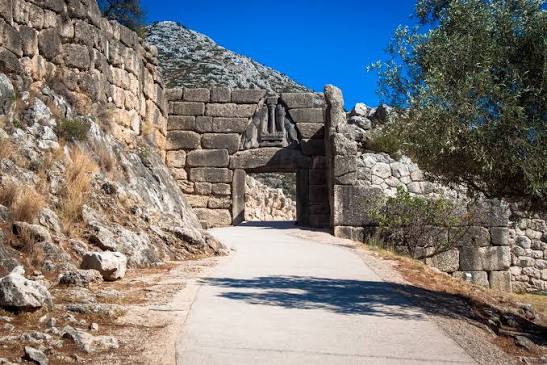
The Lion Gate provides the famous entrance into the citadel.
Built from enormous stone blocks, the gateway is crowned by a triangular relief showing two large animals facing a central element.
The exact interpretation of the image has been debated, but its visual power is immediate.
Passing through the gate is one of the defining moments of a visit to Mycenae because the monument functions both as architecture and a statement of authority.
The massive construction also introduces visitors to the defensive system surrounding the citadel.
Cyclopean Walls
Ancient Greeks of later periods looked at the enormous stone fortifications of Mycenae and associated them with the Cyclopes, mythical giants capable of moving stones beyond normal human strength.
The term Cyclopean architecture remains attached to this type of massive Mycenaean masonry.
The walls follow the natural form of the hill and create a powerful impression even in ruin.
They also reveal the importance of defense, control, and political authority in Mycenaean palatial society.
Visitors should take time to look at the scale of individual blocks rather than focusing only on the better-known monuments inside the citadel.
Grave Circle A
Immediately inside the Lion Gate lies Grave Circle A, one of the most famous archaeological areas at Mycenae.
Excavations revealed elite burials accompanied by extraordinary grave goods, including gold objects that became iconic symbols of Mycenaean archaeology.
The discoveries helped establish the wealth and status of the community that occupied the site centuries before Classical Athens reached its height.
Many of the original objects are preserved in museum collections rather than remaining in the open graves, so visiting the archaeological museum helps place the burial area in context.
The grave circle also demonstrates how monuments from different phases of Mycenae’s history were incorporated into the later fortified citadel.
Palace and Citadel
The route through the citadel rises toward the area where the palace once stood.
Although the buildings survive mainly as foundations, their position makes the hierarchy of the site clear.
The palace occupied the highest and most commanding part of the hill, overlooking routes and plains below.
Mycenaean palaces were not simply royal residences. They were centers of administration, storage, craft production, redistribution, religion, and political authority.
Understanding that broader function makes the ruins easier to interpret.
The site’s steep terrain also reminds visitors that Mycenae was designed around a defensible hill rather than a flat civic landscape.
The Treasury of Atreus
Outside the main citadel stands the Treasury of Atreus, one of the most impressive surviving tholos tombs of the Mycenaean world.
Despite its traditional name, the structure was not a treasury in the modern sense.
A long passage leads toward a monumental doorway and an enormous beehive-shaped chamber constructed using corbelled stonework.
Standing inside reveals the technical skill required to create such a large enclosed space without modern construction methods.
The tomb is often associated in popular tradition with Atreus or Agamemnon, but these identifications belong to later naming conventions rather than secure archaeological proof.
Even without a known occupant, the architecture remains extraordinary.
Agamemnon, Myth and Archaeology
Mycenae is deeply connected in Greek tradition with King Agamemnon, leader of the Greek forces at Troy.
Stories surrounding Agamemnon, Clytemnestra, Orestes, Electra, and their family became central subjects of ancient Greek tragedy and later European literature.
Archaeology cannot confirm these mythological narratives as straightforward historical biography.
However, the discovery of a powerful Bronze Age citadel at Mycenae demonstrated that the landscape remembered by later Greek storytelling was connected with a real and sophisticated prehistoric civilization.
This distinction is worth preserving. The site becomes more interesting, not less, when archaeology and myth are allowed to illuminate one another without being treated as identical.
Archaeological Museum of Mycenae
The museum near the site helps visitors understand what they see across the citadel and surrounding tombs.
Displays present objects and information connected with settlement, burial practices, religion, administration, trade, and everyday life.
The museum is especially useful after walking through stone foundations because artifacts restore a human scale to the archaeological landscape.
Pottery, tools, jewelry, figurines, and other finds show that Mycenae was not only a fortress of legendary rulers but a functioning community with complex social and economic systems.
Allow time for the museum rather than treating it as an optional final room.
Combine Mycenae with Nafplio
Nafplio is one of the most natural additions to a Mycenae day trip.
After spending several hours among Bronze Age fortifications and tombs, visitors can continue toward a historic seaside town with neoclassical buildings, Venetian fortifications, cafes, restaurants, and a waterfront promenade.
The contrast makes the day more varied.
Mycenae is monumental and archaeological. Nafplio is walkable, urban, colorful, and relaxed.
For travelers who do not want another major archaeological site after Mycenae, this combination can be preferable to a denser itinerary.
Combine Mycenae with Epidaurus
Epidaurus creates another strong pairing.
Its famous theater and Sanctuary of Asklepios belong to a very different period and cultural environment from Mycenae.
Visiting both allows travelers to move from Bronze Age palatial civilization to the religious and architectural world of later ancient Greece.
Adding Nafplio as well is possible, but the three-stop route becomes a long day and requires an early departure.
Visitors should decide whether they prefer breadth or more time at each destination.
Private Transfer from Athens to Mycenae
A private transfer with Book Athens Transfers provides direct transportation from Athens toward Mycenae.
Your pickup can be arranged from accommodation, Athens Airport, or another agreed location.
Private transfer services become especially useful when Mycenae forms part of a wider route through the Argolid region because the day’s schedule can include additional destinations without requiring travelers to organize each connection separately.
For a simple Mycenae-only excursion, the return can remain relaxed and focused on the archaeological site.
Premium Transfer to Mycenae
A premium transfer provides additional comfort for the journey into the Peloponnese.
Executive vehicles are suitable for couples, business travelers, special occasions, and visitors who prefer a more refined road experience.
The longer route also gives travelers time to observe the transition from Athens through the Corinth corridor and into the agricultural landscapes of the Argolid.
When combining multiple destinations, comfortable transportation becomes even more valuable because a large part of the day is spent moving between sites.
Athens Airport Minivan for Families and Groups
An Athens Airport Minivan is practical for families and larger groups visiting Mycenae.
Additional space allows passengers to travel together while simplifying coordination for an early departure or multi-stop itinerary.
When arranging your athens transfer or excursion with Book Athens Transfers, provide passenger numbers and the destinations you want to combine.
Visitors should also remember that the citadel includes slopes, steps, uneven stone surfaces, and exposed areas, so comfortable footwear, water, and sun protection are important.
Experience Mycenae Beyond the Legends
The stories of Agamemnon and the Trojan War attract many people to Mycenae, but the archaeology is powerful enough to stand on its own.
The Lion Gate, Cyclopean walls, graves, palace remains, tholos tombs, and strategic landscape reveal a complex Bronze Age society that existed centuries before the Classical monuments most visitors associate with Greece.
Learning to separate what archaeology can demonstrate from what later myth remembers makes the site even more fascinating.
Mycenae is both a real prehistoric citadel and a landscape that continued to live in Greek cultural memory for generations.
Arrive at Mycenae with Book Athens Transfers
Mycenae provides one of the strongest historical contrasts to an Athens itinerary. Instead of Classical temples and Roman monuments, visitors enter a fortified Bronze Age center whose architecture, tombs, myths, and archaeological discoveries reshaped modern understanding of early Greece.
Booking your athens transfer with Book Athens Transfers provides an organized journey from Athens into the northeastern Peloponnese. Choose private transfer services for a direct itinerary, a premium transfer for additional comfort, or an Athens Airport Minivan when traveling with family or a larger group.